
Ageing undoubtedly involves accumulating molecular damage. But cellular function also depends on something more fundamental: the ability to maintain order.
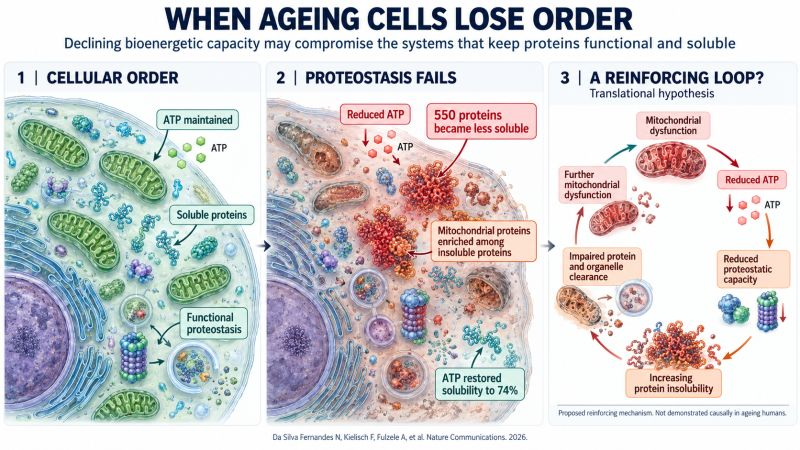
A protein can still be present inside a cell, but if it falls out of solution the cell may effectively lose access to it.
Maintaining that order takes energy.
We usually think of ATP as the cell’s energy currency. But ATP also supports molecular chaperones and helps keep proteins soluble.
So falling ATP may create problems far beyond reduced energy availability.
A new Nature Communications study followed human fibroblasts progressively into replicative senescence.
As senescence developed, protein quality control began to unravel.
Autophagic and proteasomal activity declined. Ubiquitin signalling changed. Translation machinery deteriorated.
550 proteins became less soluble.
The interesting bit viewed through my clinical bioenergetics lens is that ATP levels were lower in senescent cells. When ATP was added experimentally, 74% of those insoluble proteins became soluble again.
Crucially though some did not.
Mitochondrial ribosomal proteins were particularly resistant. Other mitochondrial proteins were also disproportionately represented among those becoming insoluble.
That creates an intriguing possibility.
Mitochondrial decline could reduce ATP availability.
Reduced ATP could make proteostasis harder to maintain.
Mitochondrial proteins become less soluble.
Protein clearance deteriorates.
Mitochondrial function declines further.
That loop is my inference. The paper does not demonstrate that it occurs causally in an ageing human.
But biologically, it is a question worth asking.
This sits close to my research into cellular stress and the unfolded protein response. Cells can tolerate substantial stress while the systems responsible for restoring order retain sufficient capacity.
Perhaps loss of that capacity is part of what matters in ageing.
This is also why I remain so interested in bioenergetics.
Energy is part of how a cell preserves order.
That does not make ATP depletion the cause of ageing.
But it strengthens the idea that bioenergetic capacity may sit upstream of several processes we subsequently recognise as ageing, including impaired repair, declining protein quality control, defective organelle turnover and cellular senescence.
Which leaves an interesting translational question.
Can we preserve energetic and proteostatic resilience for long enough to reduce the likelihood that an ageing cell crosses into stable senescence?
This study cannot answer that. These are cultured fibroblasts, not ageing humans.
But perhaps one important feature of an ageing cell is not simply how much damage it has accumulated.
It is how much capacity it still has to restore order when damage occurs.
Da Silva Fernandes N, Kielisch F, Fulzele A, et al. Quantitative proteomics reveals coordinated changes in the proteome during replicative senescence. Nature Communications. 2026;17:9877.
