
I’m a proteomics enthusiast and have been since my lab days 20 odd years ago.
However one of the uncomfortable things about modern ‘omics is that you can build an extraordinarily sophisticated measurement system and still miss biology that was never in the search space.
Proteomics has this problem in a very literal way. Mass spectrometry identifies peptides partly by matching what it detects against a reference set of proteins. If a genuine protein isn’t represented properly in that catalogue, the machine hasn’t necessarily failed. We may simply have failed to tell it what to look for.
A new Nature Aging paper makes the point rather nicely.
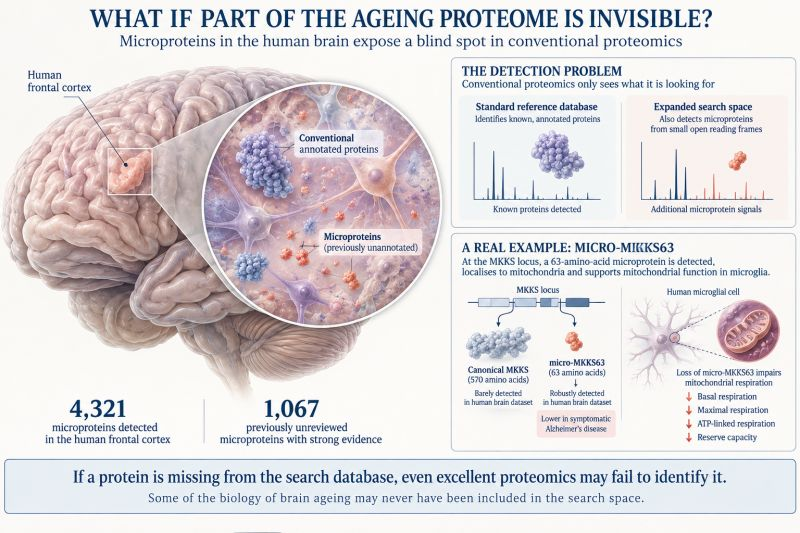
The researchers analysed more than 600 human frontal cortex samples and deliberately looked for microproteins — very small proteins encoded by short open reading frames that conventional annotation has often ignored.
They identified 1,067 previously unreviewed microproteins with strong spectral evidence.
The MKKS locus gives a particularly good example.
MKKS is conventionally annotated as producing a 570-amino-acid protein. In these human brain datasets, that canonical protein was barely detectable. Instead, the dominant detectable product was a 63-amino-acid microprotein, which the researchers called micro-MKKS63.
It wasn’t just molecular debris.
micro-MKKS63 localised to mitochondria in human microglial cells. Knocking it out reduced basal and maximal mitochondrial respiration, ATP-linked respiration and reserve capacity. Its abundance was also lower in symptomatic Alzheimer’s disease.
None of that proves that loss of micro-MKKS63 causes Alzheimer’s disease, and microprotein discovery is technically difficult enough that novel identifications need proper validation.
What I find more interesting is the implication for the way we study ageing.
We now generate extraordinary amounts of proteomic data and increasingly use them to describe pathways, build ageing clocks and identify therapeutic targets. But those analyses are still constrained by the biological catalogue underneath them.
If part of the proteome has been systematically under-annotated, then some apparently comprehensive maps of ageing biology may not actually be comprehensive at all.
That doesn’t invalidate proteomics. It makes the field considerably more interesting.
In this case, a tiny protein largely absent from the conventional picture turns out to be the predominant detectable product of its locus in human brain and appears to matter to microglial mitochondrial function.
How much other ageing biology have we been trying to explain without knowing that some of the proteins involved were even there?
Reference: Miller B, Vieira de Souza E, Lau C, et al. A microprotein atlas of the human frontal cortex in Alzheimer’s disease. Nature Aging. 2026;6:1979–1997. doi:10.1038/s43587-026-01207-x.
