
IL-11, fibrosis and ageing.
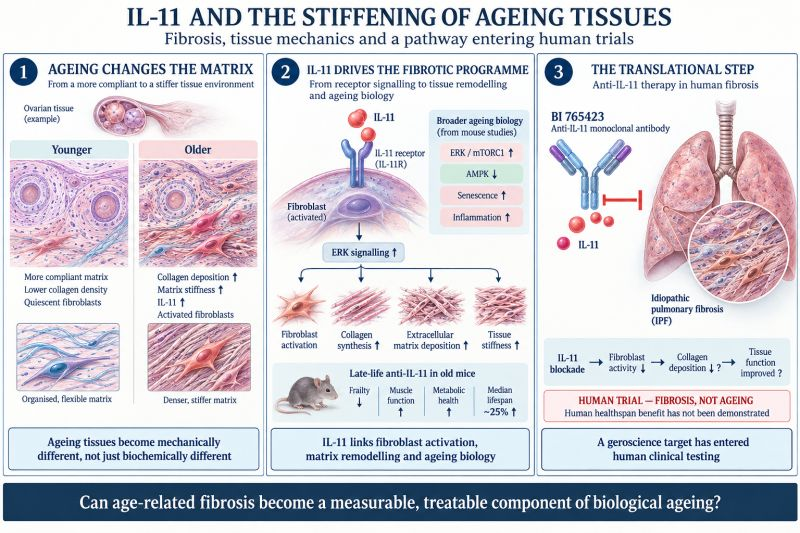
A paper in Nature Aging this summer looked at ovarian ageing through a mechanical lens: the tissue gets stiffer with age.
That principle is hardly unfamiliar. We see it very clearly in the vasculature, where arterial stiffening contributes to hypertension and changes the mechanical environment experienced by the endothelium. Tissue ageing is not just a biochemical process. The physical properties of the extracellular matrix change as well, and cells have to function inside that altered environment.
In the ovary, the researchers found that matrix stiffness increased with age and IL-11 rose alongside it.
They then worked through the mechanism. IL-11 activated fibroblasts, increased collagen production and drove matrix stiffening through ERK signalling. In mice, deleting the IL-11 receptor reduced this fibrosis. Suppressing IL-11 in aged mice and rats reduced matrix stiffness and improved ovarian function and fertility.
That interested me because it fits a much broader pattern.
In 2024, another group showed that IL-11 rises across multiple tissues with age. Blocking it in already-old mice improved muscle strength, metabolic health and frailty. Starting treatment at 75 weeks extended median lifespan by 22.5% in males and 25% in females.
The mechanism again involved familiar ageing biology: increased ERK–mTORC1 signalling, suppression of AMPK, senescence, inflammation and fibrosis.
The 25% lifespan figure is inevitably the part that gets attention.
The fibrosis bit I find is more interesting.
As tissues age, extracellular matrix accumulates, compliance changes and normal cell–matrix signalling becomes progressively distorted. We usually name the problem once it becomes disease — pulmonary fibrosis, cirrhosis, cardiac fibrosis, renal fibrosis — but the underlying biology develops long before that point.
IL-11 may be one of the signals helping to drive that transition.
And there is now a useful translational twist.
BI 765423, a monoclonal antibody targeting IL-11, is in a randomised Phase IIa trial in idiopathic pulmonary fibrosis.
That trial is not testing ageing. It will not tell us whether IL-11 blockade extends human healthspan.
But it does begin to answer a prerequisite question: can we inhibit this pathway safely enough in humans to alter fibrotic tissue biology?
That is where this becomes interesting for ageing medicine.
The next step is not to turn a 25% mouse lifespan result into a longevity treatment. It is to identify whether there are human ageing phenotypes in which excessive IL-11 signalling and progressive matrix remodelling are actually driving loss of function.
And, if there are, whether we can measure that biology well enough to know who should be treated and whether we have changed it.
References
Wu M, Zhu Q, Xiong J, et al. Modulating IL-11-dependent matrix stiffness to delay ovarian aging. Nature Aging. 2026;6:1395–1416. doi:10.1038/s43587-026-01159-2. This is the current paper showing age-related ovarian matrix stiffening, increased IL-11, fibroblast activation/collagen deposition, and improvement with IL-11 pathway suppression in aged rodents.
Widjaja AA, Lim WW, Viswanathan S, et al. Inhibition of IL-11 signalling extends mammalian healthspan and lifespan. Nature. 2024;632:157–165. doi:10.1038/s41586-024-07701-9. Late-life anti-IL-11 treatment improved metabolic and muscle function, reduced frailty, and extended median lifespan by 22.5% in male and 25% in female mice.
Clinical Trial:
ClinicalTrials.gov NCT07036523. A Study to Find Out Whether BI 765423 Has an Effect on Lung Function in People With Idiopathic Pulmonary Fibrosis (IPF) With or Without Standard Treatment. Boehringer Ingelheim. Currently recruiting; BI 765423 is being tested against placebo with lung-function and pharmacodynamic outcomes.
