
This is a fascinating paper.
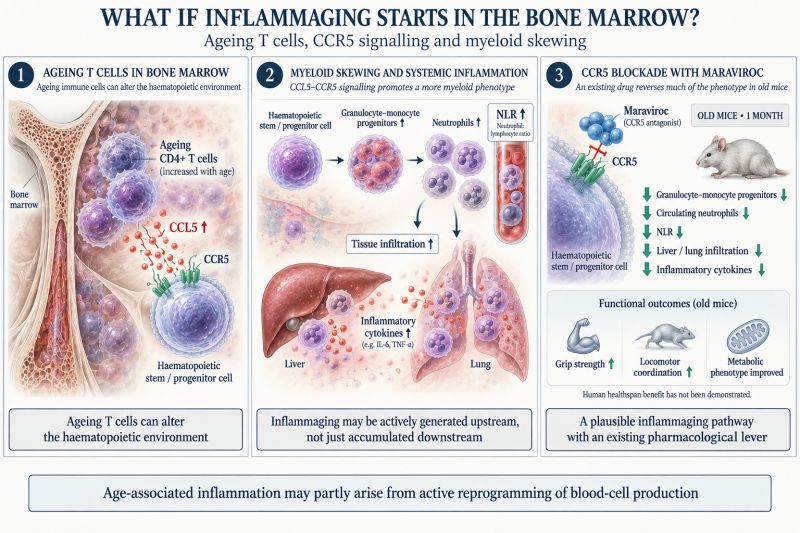
Ageing CD4+ T cells accumulate in the bone marrow and appear to drive haematopoiesis towards a more inflammatory, myeloid phenotype through CCL5–CCR5 signalling.
The result in old mice was more granulocyte–monocyte progenitors, more circulating neutrophils, a higher neutrophil:lymphocyte ratio and greater neutrophil infiltration into tissues.
So far, interesting ageing biology.
The bit that really caught my attention was what they did next.
They gave the old mice maraviroc, a CCR5 antagonist that we already use clinically in HIV medicine.
After a month there were fewer granulocyte–monocyte progenitors and circulating neutrophils, less neutrophil infiltration into liver and lung, and lower inflammatory cytokines. Grip strength, locomotor coordination and some metabolic measures improved as well.
That raises a rather different way of thinking about inflammaging.
We tend to regard chronic inflammation as something that accumulates downstream as tissues age and become dysfunctional. This suggests that part of it may be actively generated upstream, with ageing T cells altering how the bone marrow produces the next generation of immune cells.
And CCR5 is druggable – now.
Before any longevity “influencer” starts pushing maraviroc for longevity, this was a mouse study. We have no evidence that CCR5 blockade improves healthspan in healthy older humans, and maraviroc is a proper drug with proper adverse effects and interactions.
But I would like to know whether the same CCL5–CCR5 / myeloid-skewing phenotype exists in a definable group of older humans.
Particularly because the clinical footprint may already be sitting in something as mundane as the full blood count.
We routinely see neutrophil:lymphocyte ratio drift upwards with age and cardiometabolic disease. Usually we treat it as a rather non-specific marker of inflammation.
Perhaps in some patients it is telling us something about where that inflammation is coming from.
That is well worth following.
Reference: Nature Aging, 26 August 2026. CCL5–CCR5 signalling, age-associated myeloid skewing and maraviroc intervention in old mice.
