
There is a danger that GLP-1 drugs become so good at producing weight loss that we start confusing weight loss with the finished job.
A new analysis from the S-LiTE randomised trial is a useful reminder that they aren’t the same thing.
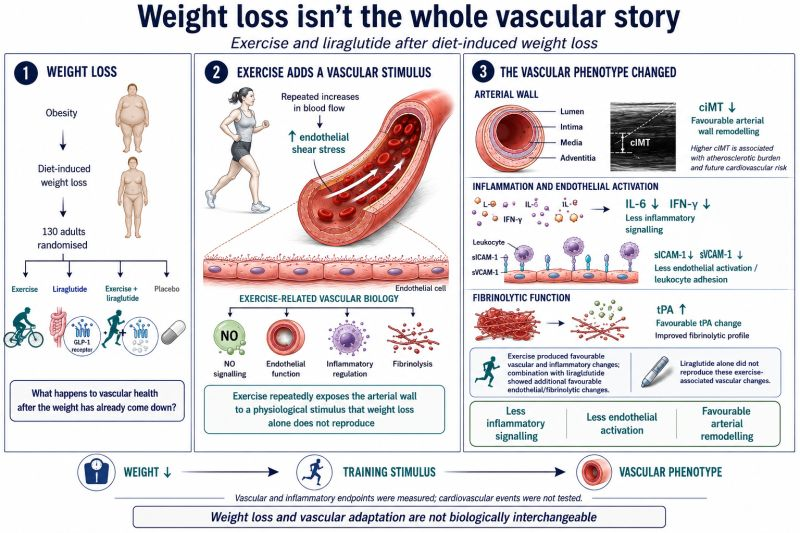
130 adults with obesity lost weight and were then randomised for a year to exercise, liraglutide, both, or placebo.
Exercise reduced carotid intima-media thickness (cIMT), alongside IL-6 and IFN-γ. Combining exercise with liraglutide also improved markers of endothelial activation and fibrinolysis.
Why is that interesting?
cIMT is quite literally the measured thickness of the inner layers of the carotid artery wall. It increases with vascular remodelling and atherosclerotic burden and is associated with future cardiovascular risk. Seeing it move in the favourable direction over a year is rather more tangible than another change on the scales.
The other markers tell a related story. Lower IL-6 and IFN-γ suggest less inflammatory drive. Lower sICAM-1 and sVCAM-1 suggest less endothelial activation and leukocyte adhesion, part of the machinery by which inflammation gets recruited into the vessel wall. Changes in tPA point towards improved fibrinolytic function.
In other words, the vascular environment became less inflammatory, less activated and potentially less atherogenic.
Liraglutide alone didn’t reproduce those changes.
Exercise does things to the vasculature that losing weight cannot necessarily replicate. Every bout changes blood flow and shear stress across the endothelium, affecting nitric oxide signalling, vascular inflammation and ultimately the behaviour of the vessel wall itself.
There is also the other half of the equation. Losing 15 or 20% of body weight while remaining weak and aerobically unfit is not my idea of successful healthspan medicine.
GLP-1 drugs are remarkable tools. But they don’t provide a training stimulus, preserve muscle by magic or exercise the endothelium for you.
This paper doesn’t show that adding exercise to a GLP-1 reduces cardiovascular events. These were vascular and inflammatory endpoints from a prespecified secondary analysis, so that would be taking the result too far.
But it does reinforce how we should probably be thinking about success.
Don’t just follow the kilos.
Follow the muscle, aerobic capacity, blood pressure, ApoB and metabolic health. And increasingly, think about what is happening to the vasculature itself.
Getting lighter is useful.
The ambition should be considerably higher than that.
Reference: Sandsdal RM et al. Effects of exercise and liraglutide on vascular health and inflammation during weight loss maintenance: a prespecified secondary analysis of the S-LiTE trial. Nature Metabolism. 2026;8:1483–1488.
