
Can Light Affect Biology?
I’ve followed photobiomodulation for some time. The mechanistic case has always been intriguing, but the human evidence hasn’t really kept pace with the enthusiasm around it.
This caught my attention.
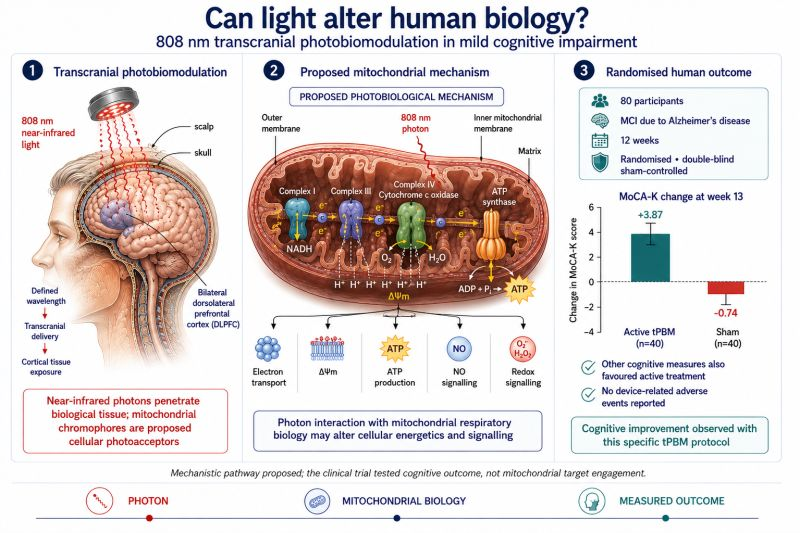
80 people with mild cognitive impairment due to Alzheimer’s disease were randomised to 808 nm transcranial near-infrared light or sham, six times a week for 12 weeks.
MoCA-K improved by 3.87 points in the treatment group and fell by 0.74 points with sham. Other cognitive measures also favoured treatment, with no device-related adverse events reported.
It’s a small RCT, but those results are worth looking at.
The biology is where I think this gets really interesting. Cytochrome c oxidase, Complex IV of the mitochondrial respiratory chain, is one proposed photoacceptor for near-infrared light. Effects on electron transport, nitric oxide and redox biology could plausibly follow.
We don’t know that this explains the cognitive effect. The trial didn’t measure it.
But think about the proposition for a moment: photons at a defined wavelength interacting with mitochondrial machinery and potentially changing cellular behaviour.
This is also why I’m interested in quantum biology. Unfortunately, stick the word “quantum” anywhere near medicine and you’ll rapidly find someone selling a frequency mat.
That’s a pity. Electron transfer, tunnelling, photon absorption and spin chemistry are real physical phenomena, and biology has had several billion years to exploit physics.
The question is which of them we can exploit too.
This trial doesn’t get us there. It does make photobiomodulation rather harder to dismiss as another wellness fad.
Reference: Chun H, Lee HW, Hong SB, Ha SS, Yoon KJ. Home-based transcranial photobiomodulation improves cognitive function in mild cognitive impairment due to Alzheimer’s disease: a randomized, double-blind, placebo-controlled confirmatory trial. Journal of Alzheimer’s Disease. 2026;111(4):1699–1707.
