
MOTS-c Clinical Trial – a step forward for peptide medicine.
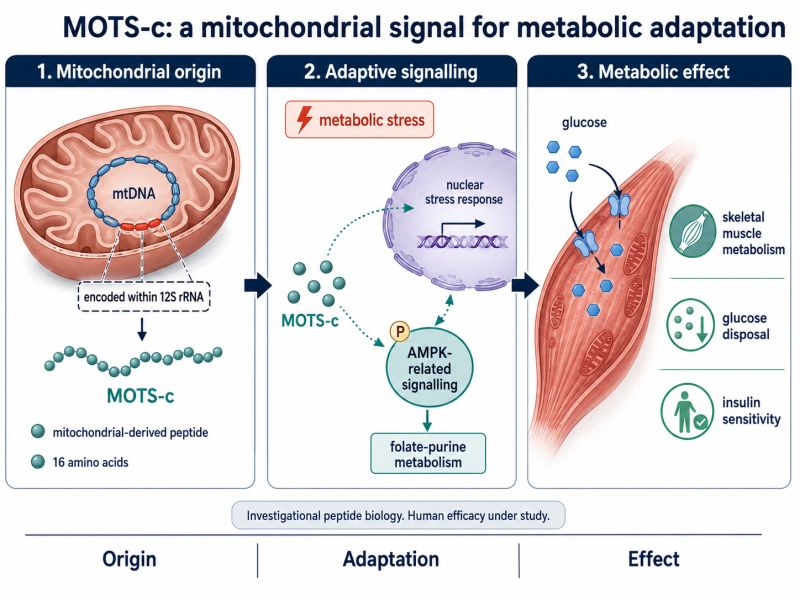
MOTS-c is a 16-amino-acid mitochondrial-derived peptide encoded within the mitochondrial 12S rRNA region.
It belongs to the emerging biology of mitochondria as signalling organelles.
Not just power stations, but systems that help coordinate metabolic adaptation.
MOTS-c appears to act particularly through skeletal muscle, glucose handling, AMPK-related nutrient sensing, the folate cycle and de novo purine biosynthesis.
In the original Cell Metabolism work, MOTS-c improved metabolic homeostasis in mice, protecting against high-fat-diet-induced obesity, insulin resistance and age-related insulin resistance.
It has now entered a Phase 2a randomised, double-blind, placebo-controlled trial in adults with prediabetes and overweight or obesity.
That trial phenotype is important, but it is not the boundary of the biology.
Prediabetes with excess adiposity is a clean place to test the signal because insulin sensitivity can be measured. The wider clinical question is bioenergetic:
*Who has impaired metabolic flexibility?
*Who has poor skeletal-muscle glucose disposal?
*Who has inflammatory or adipose-driven mitochondrial stress?
*Who has lost the ability to respond properly to training, fasting, feeding and recovery?
Those are more interesting questions than “who feels tired?”
MOTS-c should not be reduced to another influencer stack for people who want more energy by Friday.
If you are trying to influence mitochondrial signalling, you need to understand the terrain first.
Sleep. Nutrition. Resistance training. Insulin resistance. Muscle mass. Inflammation. Liver fat. Thyroid status. Medication context. Recovery capacity.
The ground has to be prepared before the signal is added.
That is why I am pro-peptide, but not pro-sloppy peptide medicine.
A serious MOTS-c trial strengthens the case for the biology. It does not validate grey-market vials, copied dosing schedules or clinics selling mitochondrial shortcuts without measuring mitochondrial-relevant outcomes.
The outcomes should be concrete:
insulin sensitivity
glucose handling
body composition
waist circumference
liver fat
exercise tolerance
recovery
safety after stopping
MOTS-c may become an important metabolic peptide.
I hope it does.
But if it does, it will belong to clinical bioenergetics, not wellness theatre.
Scout-led medicine asks the question early.
Responsible medicine prepares the ground, selects the phenotype, measures the response and stays honest about what remains unproven.
References
Lee C et al.
The mitochondrial-derived peptide MOTS-c promotes metabolic homeostasis and reduces obesity and insulin resistance.
Cell Metabolism, 2015.
ClinicalTrials.gov — NCT07505745
MOTS-c for Improving Insulin Sensitivity in Adults With Prediabetes and Overweight/Obesity.
Kim SJ et al.
The mitochondrial-encoded peptide MOTS-c translocates to the nucleus to regulate nuclear gene expression in response to metabolic stress.
Cell Metabolism, 2018.
Reynolds JC et al.
MOTS-c is an exercise-induced mitochondrial-encoded regulator of age-dependent physical decline and muscle homeostasis.
Nature Communications, 2021.
Woodhead JST et al.
Acute endurance exercise stimulates circulating levels of mitochondrial-derived peptides in humans.
Journal of Applied Physiology, 2021.
