
Businesses already manage key-person risk.
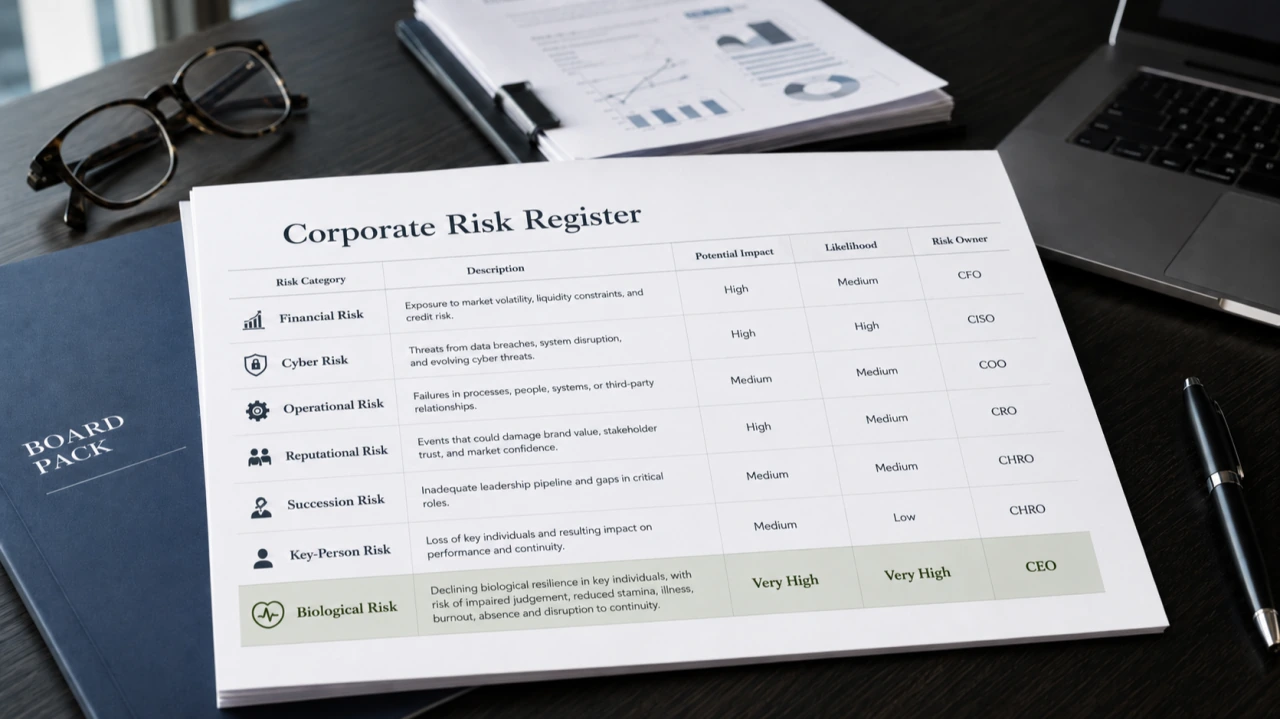
They insure against it. They build succession plans around it. They discuss founder dependency, client concentration, operational fragility, cyber exposure, reputational risk and the loss of critical talent.
But they rarely ask a more basic question.
How biologically resilient are the people on whom the business depends?
A senior partner does not become fragile on the day of a cardiac event, burnout episode, cognitive wobble, depressive collapse, metabolic decompensation or prolonged sickness absence. The risk usually accumulates quietly: poor sleep, hypertension, insulin resistance, visceral fat, inflammatory load, alcohol drift, chronic stress exposure, low cardiorespiratory fitness, loss of muscle, menopause disruption, undiagnosed sleep apnoea and a gradual narrowing of physiological margin.
By the time the organisation notices, the issue has often moved from prevention to disruption.
That is why biological resilience belongs closer to the corporate risk register than the wellbeing calendar.
This is particularly obvious in law, finance, advisory, professional services and founder-led businesses. These organisations often depend on a small number of senior people whose value is not simply their hours worked. Their value sits in judgement, memory, client trust, negotiation, stamina, emotional regulation, institutional knowledge and the ability to remain accurate under pressure.
The legal market already understands this economically.
Major, Lindsey & Africa’s 2024 US Partner Compensation Survey, covering partners at the 200 largest US law firms, reported average partner originations of $3.476 million, up 26% from 2022. It also found that equity partners generated more than four times the business of non-equity partners on average, with the average partner billing rate reaching $1,114 per hour.
So senior partners are not just employees. In commercial terms, they are often revenue-bearing assets. The lateral market prices them that way. Firms compete for books of business, client relationships and rainmaking capacity. Yet the same firms often treat the biological resilience of those people as a private lifestyle issue until illness, absence or underperformance forces a response.
That is inconsistent.
The broader labour market data already show that health is not a soft business issue. The Office for National Statistics reported that, in 2025, workers with long-term health conditions had a sickness absence rate of 4.0%, compared with 1.0% for those without long-term health conditions. Managers, directors and senior officials had the lowest sickness absence rate among major occupational groups, also at 1.0%.
That low absence rate in senior people should not be reassuring on its own. Senior people often keep working while biologically depleted. They are less likely to disappear early and more likely to continue carrying responsibility while judgement, recovery, sleep, mood, energy or cognitive bandwidth are already deteriorating.
Absence is visible. Presenteeism is often more dangerous.
The UK Government’s Keep Britain Working review estimated that presenteeism — working while unwell — costs employers the equivalent of 4 to 9 lost productive days per person per year through poor decision-making, extended recovery times and contagion. It also estimated that replacing an employee lost to ill health costs employers over £11,000, before wider disruption is considered.
For senior people, the real cost may not be captured in those numbers. A depleted junior employee may mean lost output. A depleted senior decision-maker may mean poor judgement, delayed escalation, impaired negotiation, loss of client confidence, succession instability, cultural drag or avoidable exit.
Most corporate wellbeing does not address this properly.
Too much of it still looks like a scattered benefits menu: webinars, apps, gym discounts, awareness weeks, generic resilience sessions and occasional screening days. Some of these may be useful. They are not a serious biological risk framework.
A proper framework would ask better questions.
Which roles carry disproportionate biological dependency?
Where would illness, burnout, cognitive depletion or sudden incapacity create material commercial disruption?
Are senior people relying on episodic private healthcare that responds to illness, but does not manage biological trajectory?
Are health interventions clinically governed, or are they wellness products with better branding?
Is testing clinically owned, interpreted and followed up, or is it test retail masquerading as medicine?
The distinction is important. Testing alone is not strategy. A blood panel, wearable, DEXA scan, genetic test or biological age estimate has limited value unless it sits inside proper medical interpretation, confidentiality, intervention and longitudinal accountability.
The standard has to be clinical, not cosmetic.
A serious approach would start with fundamentals: cardiovascular risk, blood pressure, ApoB and lipid risk, insulin resistance, body composition, sleep, alcohol, liver and renal markers, inflammatory load, cardiorespiratory fitness, muscle and strength, medication optimisation, menopause and hormonal health where clinically relevant, mental health risk, cancer screening alignment and recovery capacity.
Most of the early gains would come from identifying and managing common, measurable, modifiable risks that are often missed or under-treated in high-performing people because they are busy, functional and apparently coping.
High-functioning is not the same as biologically resilient.
None of this justifies employer access to individual medical data. Biological risk management must not become biological surveillance. Senior employees should not be coerced into testing, and employers should not receive personal results. Medical data should remain confidential, clinically held and consent-based.
But boards can legitimately ask whether a governed pathway exists.
The UK Corporate Governance Code expects boards to monitor risk management and internal control frameworks and review their effectiveness. It also expects companies to explain procedures for identifying and managing emerging risks.
For some businesses, biological risk is now one of those emerging risks.
Cyber risk was once treated as an IT issue. It is now a board issue. Mental health was once treated as a private weakness. It is now recognised as a workplace and performance issue. Climate risk moved from values language into investor, insurance and governance language.
Biological risk will follow a similar path in organisations where senior human capital is central to value creation.
Businesses built on judgement, trust, expertise and leadership continuity should stop pretending that the biological condition of their key people is outside the risk conversation.
If a firm knows the profitability of a client relationship, the utilisation of a partner, the revenue exposure of a team, the cyber maturity of its systems and the succession risk around a senior leader, but knows nothing about the preventable biological fragility accumulating in its most important people, the risk map is incomplete.
Biological resilience is becoming a measurable strategic asset.
