
What if some of the benefits of exercise could be bottled?
It sounds like the sort of promise you’d expect from the supplement industry.
But a fascinating new study suggests there may be some serious biology behind the idea.
Researchers have transferred molecular signals associated with exercise into ageing cartilage cells, restoring aspects of their youthful function.
And the implications could extend well beyond osteoarthritis.
We tend to think of osteoarthritis as joints wearing out. But cartilage is living tissue, maintained by cells whose ability to preserve its structure and function declines with age.
What if we could restore some of that capacity?
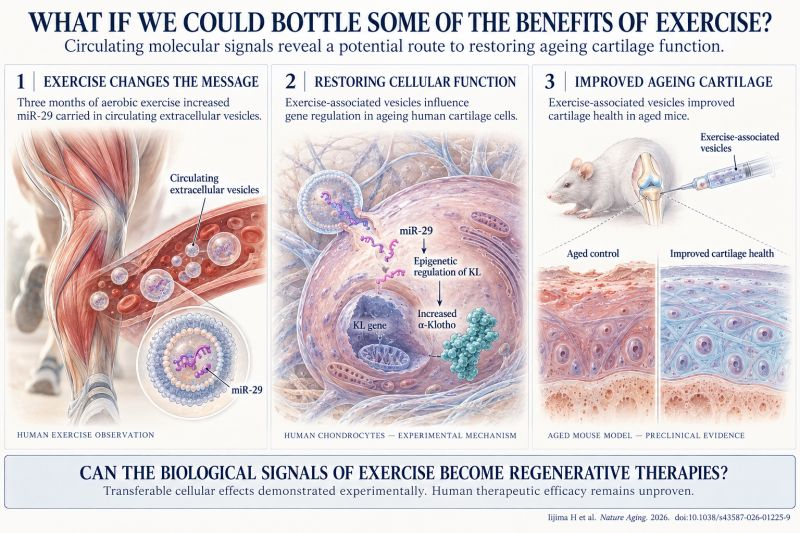
In a new Nature Aging study, researchers found that three months of aerobic exercise increased levels of microRNA-29 (miR-29) carried in circulating extracellular vesicles.
These vesicles are tiny packages of molecular information that travel between cells and can influence their behaviour.
When exercise-associated vesicles were applied to ageing human cartilage cells, the cells recovered several characteristics associated with a healthier, more youthful state.
The mechanism is particularly interesting.
MiR-29 influenced the epigenetic regulation of α-Klotho, a protein with established roles in ageing biology. By altering the regulation of the KL gene, the vesicles helped restore cellular processes involved in maintaining cartilage.
The researchers went further.
Injecting exercise-primed vesicles into the joints of aged mice improved cartilage health. And engineered vesicles enriched with miR-29 reproduced important cellular effects, partly through α-Klotho.
Think about what that suggests.
A biological signal associated with exercise can be transferred to ageing cells and change how they function.
It adds to growing evidence that some aspects of cellular ageing may be responsive to signals circulating between tissues.
This is experimental research. It doesn’t demonstrate cartilage regeneration in patients or validate commercially available exosome treatments.
But the translational possibility is fascinating.
Could we eventually identify, manufacture and deliver some of the molecular signals responsible for exercise’s benefits?
If so, we might be able to reproduce selected regenerative effects in tissues whose capacity for maintenance and repair has declined with age.
And osteoarthritis may be just one place to start looking.
References
Iijima H, et al. Exercise enhances aged chondrocyte health through microRNA-29-enriched extracellular vesicles. Nature Aging (2026).https://doi.org/10.1038/s43587-026-01225-9
