
One of the odd things about muscle ageing is that function starts slipping before the muscle visibly disappears.
Strength, power and resilience can decline before major loss of muscle mass.
We usually explain that through mitochondrial dysfunction, but a new Nature Aging paper points to something more specific: the membrane architecture that allows mitochondria to work properly.
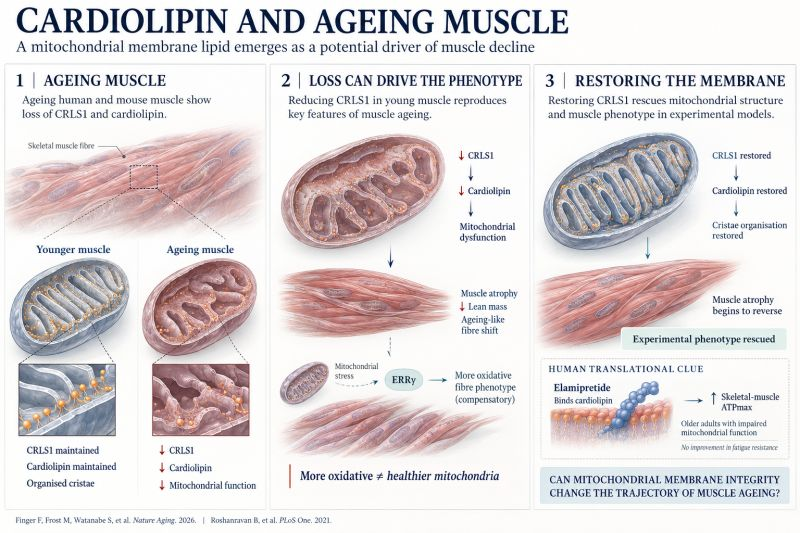
The key molecule is cardiolipin, a specialised phospholipid concentrated in the inner mitochondrial membrane. It helps maintain cristae structure and organise the machinery that generates ATP.
The researchers found lower cardiolipin and reduced expression of CRLS1, the enzyme needed to make it, in ageing skeletal muscle in both mice and humans.
Then they reduced CRLS1 specifically in young mouse muscle.
The result was mitochondrial dysfunction, loss of lean mass, muscle atrophy and an ageing-like fibre shift. So cardiolipin loss was not simply associated with muscle ageing.
Experimentally, it could reproduce important parts of the phenotype.
There was also an interesting paradox.
The stressed muscle shifted towards a more oxidative, mitochondria-rich phenotype through ERRγ signalling. At first glance that sounds adaptive. It may actually be compensation — muscle trying to preserve energy production while mitochondrial membrane integrity is failing.
More mitochondria does not necessarily mean healthier mitochondria.
When CRLS1 was restored, cardiolipin recovered, muscle atrophy began to reverse and the premature mortality caused by cardiolipin depletion was rescued.
The translational bridge: Elamipretide binds cardiolipin and is already FDA-approved for Barth syndrome, a rare mitochondrial disorder involving abnormal cardiolipin biology.
In an earlier randomised study of older adults with impaired mitochondrial function, a single dose increased skeletal-muscle ATPmax, although it did not improve fatigue resistance.
The new paper does not show that elamipretide reverses sarcopenia or human muscle ageing.
The rescue was genetic and performed in mice. But the pieces now form a serious hypothesis:
ageing muscle loses cardiolipin → cardiolipin loss can reproduce an ageing phenotype → restoring cardiolipin biology rescues much of that phenotype experimentally → cardiolipin is already pharmacologically targetable in humans.
That moves cardiolipin from an interesting mitochondrial lipid to a serious candidate mechanism in muscle ageing.
Could preserving mitochondrial membrane integrity change the trajectory before substantial muscle is lost?
We don’t yet know the answer, but this paper makes it worth exploring.
Finger F, Frost M, Watanabe S, et al. Mitochondrial membrane lipid cardiolipin controls fiber-type adaptations in aging muscle via estrogen-related receptor γ. Nature Aging. 2026.
