
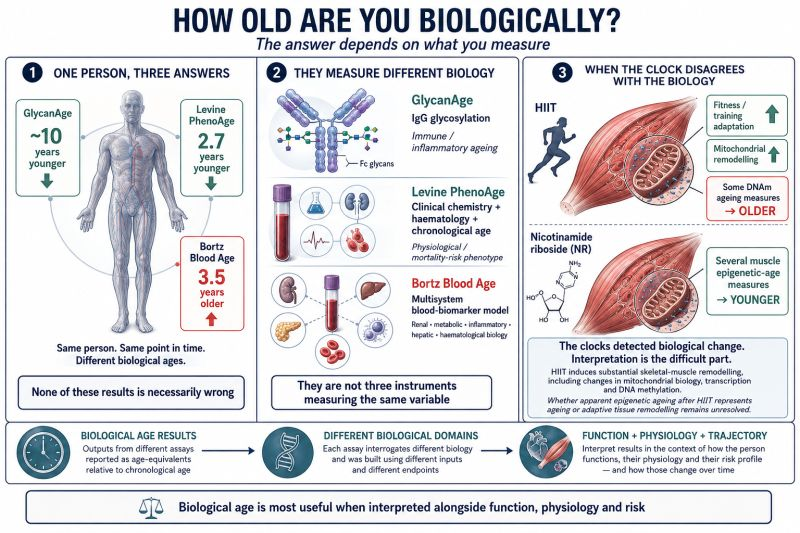
I have a patient whose biological age results currently look something like this:
GlycanAge: ~10 years younger
Levine PhenoAge: 2.7 years younger
Bortz: 3.5 years older
That’s quite a spread from three tests ostensibly telling us something about the same person’s biological ageing.
I’m not particularly troubled by it.
The temptation with biological age testing is to find the most flattering result and put that number on the front page. “You’re ten years younger” certainly makes for better marketing than explaining why another model thinks you’re three years older.
Scientifically, though, the disagreement is probably more useful.
These tests aren’t measuring the same thing. GlycanAge is looking heavily at immune/inflammatory biology through glycosylation. Levine’s PhenoAge was derived using clinical chemistry and mortality risk. Bortz uses another model again. Calling the output of each “biological age” makes them sound much more interchangeable than they really are.
Two papers published recently illustrate the problem rather nicely.
A large Nature Medicine analysis brought together 51 human intervention studies and ran multiple DNA methylation ageing measures across them. Interventions moved the clocks, but the clocks didn’t necessarily move together.
More amusingly, an Aging Cell study looked at skeletal muscle after nicotinamide riboside and after HIIT. NR made several epigenetic clocks younger.
HIIT made some of them older.
I’m reasonably confident the conclusion isn’t that we should stop exercising and take NR instead.
HIIT causes substantial remodelling of skeletal muscle, including mitochondrial biogenesis. That changes the underlying biology and, unsurprisingly, some of the methylation patterns used by ageing algorithms. Whether a clock moving forwards in that setting represents accelerated ageing is a very different question.
This is why I don’t think there is much value in chasing a single biological age number.
If three measures disagree, I want to know why. Then I want to look at what has happened to VO₂max, strength, insulin sensitivity, ApoB, inflammation, blood pressure and the rest of the person’s physiology.
Biological age tests can add another layer to that picture.
They shouldn’t be allowed to replace it.
And if your VO₂max is climbing, your metabolic health is improving and you’re getting stronger while an algorithm tells me you’ve aged six months, I’m not cancelling the exercise.
References
Sehgal R, Borrus D, Armstrong JF, et al. Responsiveness of epigenetic aging biomarkers to longevity interventions in humans. Nature Medicine. Published 21 August 2026. doi:10.1038/s41591-026-04562-9.
Heikkinen A, Uusitalo-Kylmälä L, Blom I, et al. The Divergent Effects of Nicotinamide Riboside and High-Intensity Exercise Training on Skeletal Muscle Epigenetic Aging. Aging Cell. 2026;25(8). doi:10.1111/acel.70638.
