
There’s something rather remarkable about cellular senescence.
When a cell is damaged or stressed, it can stop dividing and release signals that recruit the immune system. In wound healing, that can be useful: the cell does its job, then macrophages help clear it away.
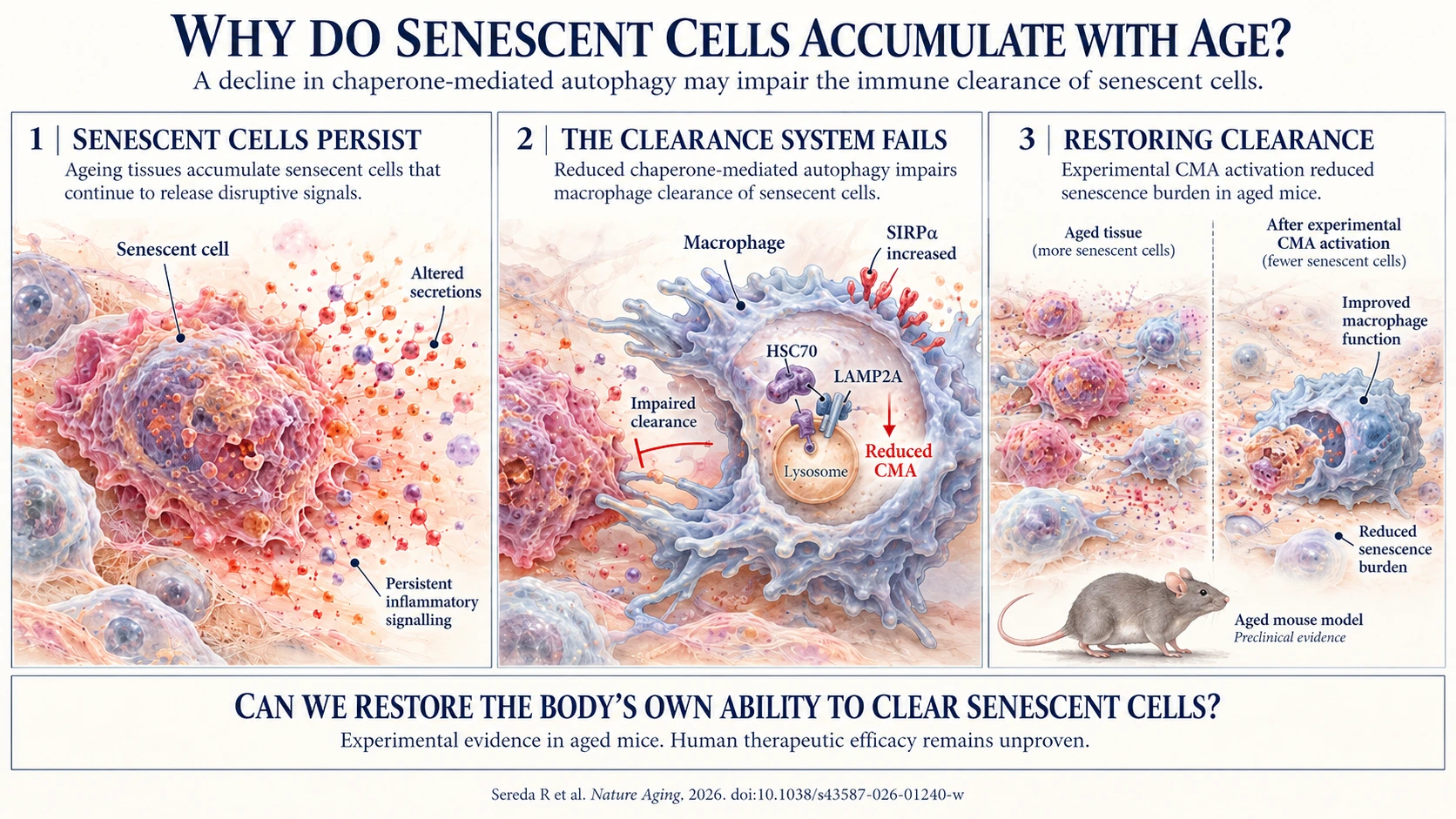
But as we age, senescent cells increasingly linger. They accumulate in tissues, release inflammatory signals and can disrupt the function of their neighbours.
We’ve spent years looking for drugs that kill them. A new Nature Aging study asks a rather different question.
What if senescent cells are helping to disable the immune cells that should remove them?
The researchers traced part of the problem to chaperone-mediated autophagy (CMA), a selective system for disposing of unwanted proteins. When CMA declines in senescent cells, their secretions change. Those altered signals can suppress CMA in macrophages — the immune cells responsible for clearing cellular debris and unwanted cells. And macrophages with impaired CMA accumulate SIRPα, part of the signalling machinery that tells them when NOT to engulf a target.
The result is a vicious circle: senescent cells become harder to clear, while their continued presence makes the clearance system less effective.
This paper also takes me back to my own scientific roots.
My earlier research involved GRP78/BiP, a molecular chaperone in the HSP70 family, and how cells respond when proteins fail to fold correctly. CMA relies on a different HSP70 family member, HSC70, to recognise selected proteins and deliver them to lysosomes.
Different cellular compartments and pathways, but the same underlying theme: the ability to maintain the proteome is fundamental to cellular function.
Crucially, the investigators tested the mechanism.
Disrupting CMA in macrophages increased senescent-cell accumulation and delayed its resolution during wound healing in mice.
An experimental CMA activator reduced senescence-associated markers in aged mice. There is no proven human rejuvenation treatment here.
The experiments are preclinical, and increasing autophagy in general is not equivalent to restoring this highly selective pathway.
But consider the therapeutic possibility. Instead of only developing compounds that directly kill senescent cells, could we restore the bodys own machinery for recognising and removing them?
That strikes me as a rather interesting direction for regenerative and healthspan medicine.
Sereda R et al. Nature Aging (2026) Decline of chaperone-mediated autophagy in aging impairs macrophage clearance of senescent cells | Nature Aging
